
In the world of modern manufacturing and interior design, engineered wood composites have largely revolutionized furniture and flooring production. Among these materials, Medium-Density Fiberboard (MDF) and High-Density Fiberboard (HDF) are two of the most widely used options. While they share a similar manufacturing lineage, their distinct physical properties dictate very different optimal applications.
The Commonalities: What MDF and HDF Share
Before looking at their differences, it is crucial to understand that MDF and HDF are essentially siblings from the same manufacturing process.
- Raw Materials: Both composites are made from wood waste, such as sawdust, wood shavings, and wood chips, which are refined into fine wood fibers.
- Binding Agents: Both utilize synthetic resins (such as urea-formaldehyde or melamine) and wax under intense heat and pressure to bond the fibers together into solid panels.
- Surface Consistency: Unlike natural timber, neither MDF nor HDF contains knots, grain patterns, or warping tendencies. Both offer a perfectly smooth, uniform surface that is highly receptive to paint, veneers, and laminates.
- Eco-Friendliness: Both materials maximize the utilization of timber resources by turning waste byproducts into high-value construction materials.
The Key Differences: MDF vs. HDF
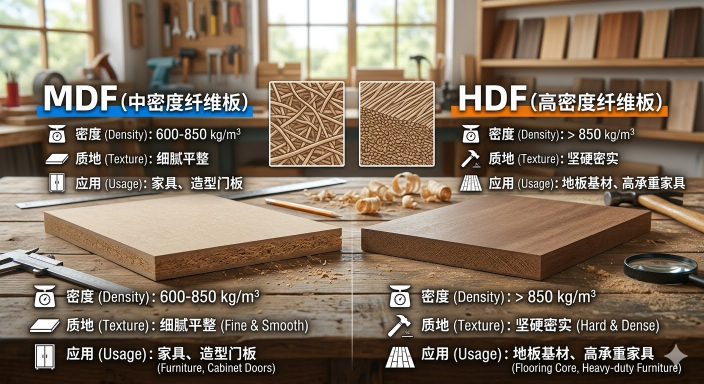
The primary technical variance between these two materials lies in the density of the compressed fibers. This single factor alters their weight, strength, cost, and usage.
1. Density and Weight
- MDF: Features a density ranging between 600 kg/m³ and 800 kg/m³. It is relatively lightweight compared to HDF, making it easier to transport and manipulate on a standard job site.
- HDF: Boasts a much higher density, typically exceeding 800 kg/m³ to 1050 kg/m³. The fibers are packed incredibly tight, resulting in a significantly heavier and stiffer panel.
2. Machinability and Workability
- MDF: Due to its lower density, MDF is highly malleable. It can be easily cut, routed, and shaped without chipping. It is the preferred material for creating intricate decorative profiles, such as 3D wall panels, cabinet doors, and crown moldings.
- HDF: Because it is extremely hard and brittle, HDF is notoriously difficult to route or carve into intricate shapes. Attempting to mill decorative profiles into HDF will quickly dull cutting tools and cause edge chipping. It is strictly cut into flat, geometric boards.
- 3. Moisture and Impact Resistance
- MDF: It has a moderate resistance to moisture but will swell and lose structural integrity if exposed to direct water or prolonged high humidity. It is also susceptible to denting under heavy impact.
- HDF: The extreme compression leaves almost no air pockets within the board, granting HDF superior impact resistance. It is highly resistant to heavy foot traffic and is much less prone to warping or swelling when exposed to humidity.
4. Cost and Availability
- MDF: Requires less raw material per square meter and less compression energy, making it much more affordable and universally available at hardware stores.
- HDF: The production process requires more fiber and higher industrial pressure, resulting in a higher price point. It is usually sourced via industrial B2B channels rather than retail home centers.