
In the resilient flooring industry, Luxury Vinyl Tile (LVT) and Stone Plastic Composite (SPC) represent two distinct generations of technology. While both are vinyl-based, their core formulations dictate completely different manufacturing setups, machinery requirements, and production capacities.
Understanding these differences is crucial for production planning, cost allocation, and quality control.
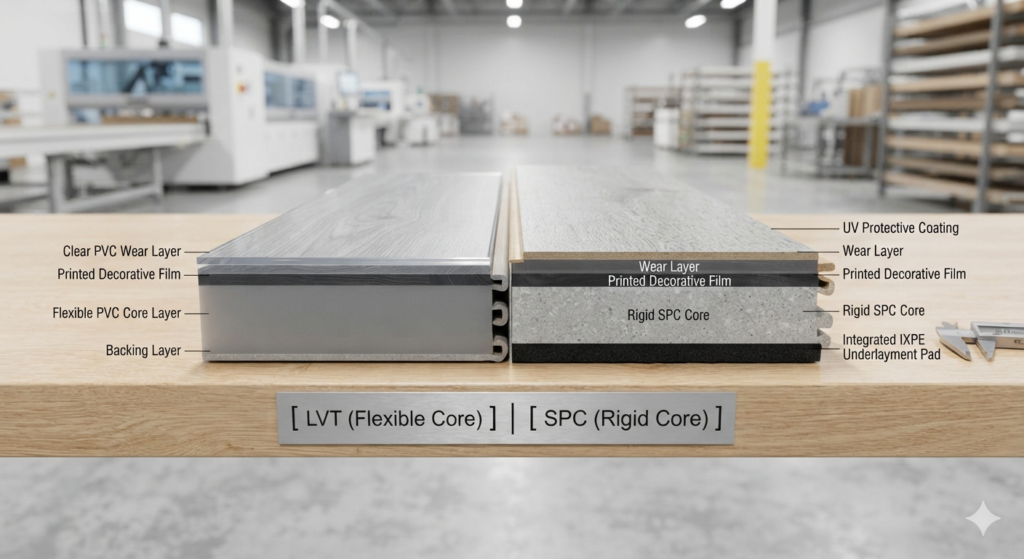
1. Core Formulations & Mixing
The fundamental difference starts with the raw materials, which dictates how the core behaves during manufacturing.
· LVT Core: Consists of PVC resin, plasticizers (for flexibility), calcium carbonate filler (in lower ratios), and stabilizers. This creates a flexible, dough-like compound.
· SPC Core: Consists of a high ratio of natural calcium carbonate (70-80%), PVC resin, and functional additives like coupling agents and toughening modifiers (specific names should be verified via factory lab reports). It contains zero or minimal plasticizers, creating a completely rigid composite.
2. Equipment & Production Workflows
The physical properties of the formulations require completely different shaping machinery.
LVT: The Hydraulic Press / Oil Press Process
Traditional LVT relies on a multi-layer assembly method using hydraulic/oil thermal press machines.
· Layer Separation: The LVT core sheets, decorative print film, and wear layer are produced separately beforehand via calendar rollers.
· Press Machine Specs: These layers are manually stacked into a hydraulic press machine. Factories utilize different press plate sizes based on product length:
o 1.0-meter press: Used for products under 1.0 meter.
o 1.3-meter press: Mandatory for standard plank sizes like 180 × 1220 mm.
o 1.5-meter & 1.8-meter presses: Used for extra-long planks or wide tiles.
· Post-Press Punching: After pressing, the large fused sheets must be die-cut or punched into individual planks before profiling.
SPC: The Continuous Twin-Screw Extrusion Process
SPC utilizes high-efficiency extrusion technology that creates a continuous sheet in one single workflow.
· Direct Extrusion: The mixed rigid compound is fed into a twin-screw extruder, melted under high heat, and forced through a T-die to form a continuous rigid sheet.
· Inline Lamination: While the SPC core sheet is still hot, the print film and wear layer are thermally laminated directly onto the core via a four-roll calendering system—no glues are required.
The High-End Hybrid Exception
For premium, high-end SPC products over 8mm in thickness, a hybrid workflow is used. The thick core is first produced on the extrusion line, and then transferred to hydraulic oil press equipment for final heavy-duty lamination and flat curing to prevent warping.
3. Technical Constraints: Click-Lock Profiles & Underlayment
Because LVT is flexible, it is often glued down or made with loose-lay or thin click profiles. SPC, being rigid, relies heavily on click-lock structural integrity, which introduces strict thickness constraints when adding IXPE/EVA underlayment pads:
· 4mm SPC: Must be configured as 4+1mm. A 4+2mm pad configuration is highly discouraged because a soft, thick pad causes the rigid click-lock joint to lose support and break under pressure.
· 5mm SPC: Restricted to 5+1mm or 5+1.5mm. A 5+2mm pad is not recommended.
· 6mm SPC: Strong enough to safely pair with a thicker 2mm underlayment pad.
4. Export Compliance & Data Consistency
Whether manufacturing LVT or SPC, international shipping demands absolute precision in documentation.
· Dimension Conversions: Cross-check all conversions between imperial units (inches) and metric units (millimeters/centimeters).
· The “Golden Thread” of Paperwork: The total volume, unit types (meters, square meters, or pieces/boxes), product specs, and total monetary amounts must match 100% identically across the Sales Contract, Commercial Invoice, Packing List, Customs Declaration Form, and Tax Invoices. Discrepancies will block customs clearance and invalidate export tax rebates.