
When planning a high-end residential or commercial project, one of the most debated topics is the choice of flooring: Solid Hardwood or Engineered Wood?
While both offer the timeless beauty of real timber, they perform very differently under the surface. As a leading manufacturer of Multi-ply Engineered Flooring, we’ve analyzed the key differences to help you make an informed decision for your next project.
1. Structure & Composition
Solid Wood: As the name suggests, it is a single, solid piece of timber from top to bottom. While traditional, its natural cellular structure makes it prone to moving.
Engineered Wood: This is a high-tech “sandwich” of wood. It features a genuine hardwood top layer (veneer) bonded over multiple layers of structural-grade plywood (such as our Full Birch or Eucalyptus core).
- The Verdict: Engineered wood provides the exact same look and feel as solid wood but with much higher structural intelligence.
2. Dimensional Stability (The “Movement” Factor)
Wood is hygroscopic, meaning it breathes. In humid summers, it expands; in dry winters, it contracts.
- Solid Wood Challenge: Because the grain runs in one direction, solid planks are notorious for cupping, crowning, or gapping when temperatures shift.
- The Engineered Solution: Our Multi-ply construction uses layers stacked in a cross-grain pattern. This cross-tension neutralizes wood’s natural urge to move.
- The Verdict: For projects in coastal areas, high-rise buildings, or regions with fluctuating seasons, Engineered Wood is the clear winner.
3. Radiant Heat Compatibility
Modern luxury often includes Underfloor Heating (UFH).
- Solid Wood: Generally NOT recommended for UFH. The direct heat can cause the wood to dry out too quickly, leading to cracks and structural failure.
- Engineered Wood: Because of its stable core, engineered flooring is the industry standard for underfloor heating. It transfers heat efficiently without compromising the integrity of the planks.
4. Sustainability & Eco-Friendliness
In today’s market, “Green” is no longer optional—it’s expected.
- Solid Wood: Consumes more slow-growing hardwood per square meter.
- Engineered Wood: We use precious hardwoods (like Oak or Walnut) only for the visible surface, while the core uses faster-growing, sustainable species. Furthermore, our use of Finland Dynea Glue ensures that your project meets the strictest CARB II and E0 emission standards.
5. Design Flexibility: Herringbone, Chevron, and Beyond
While solid wood is mostly limited to standard planks, engineered wood allows for much larger dimensions and complex patterns.
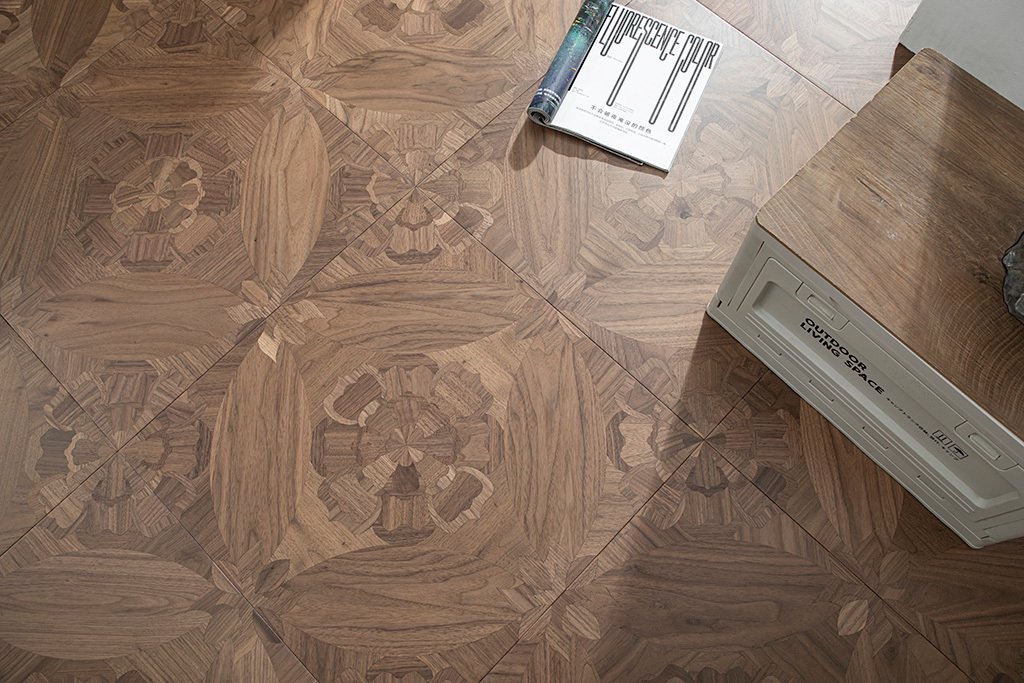
- Our Collections: Whether it’s a 60° Chevron, an Art Parquet, or an Extra-wide Plank, the stability of engineered wood allows us to create formats that would be impossible with solid timber.
Final Conclusion: Which Should You Choose?
- Choose Solid Wood only if you are restoring a historic landmark where “original materials” are a legal requirement.
- Choose Engineered Wood for almost every other modern application. It offers superior stability, better moisture resistance, eco-friendly credentials, and unbeatable design versatility.